
Gelato is a dense, churned frozen dessert whose smooth texture depends on controlling temperature, incorporating air, and freezing the mix at the right pace. Making it at home does not require a commercial machine, but a reliable thermometer, accurate scale, suitable freezer-safe containers, and either an ice-cream maker or a carefully managed no-churn method make results more consistent. The most useful equipment depends on how often you make gelato: a freezer-bowl machine is a practical starting point, while a compressor machine offers convenience for frequent batches. Good tools matter because frozen-dessert texture is sensitive to small changes in formulation and freezing conditions.
Equipment choices shape homemade gelato texture and workflow
Gelato is a style of Italian frozen dessert, not a single standardized recipe. Compared with many conventional ice creams, it is generally served warmer and made with less incorporated air, which contributes to a denser eating texture. The equipment’s job is to help prepare a consistent base, freeze it while churning, and store it without allowing excessive melting and refreezing. The University of Guelph’s food-science resources explain that ice crystals grow during temperature fluctuations; controlling freezing and storage therefore helps preserve smoothness.
A basic home setup can be grouped into three related categories: measuring and heating tools, freezing and churning equipment, and storage and serving tools. The right combination depends on recipe style, batch size, freezer space, and budget—not on owning every specialized gadget.
Measuring and heating tools support repeatable recipes
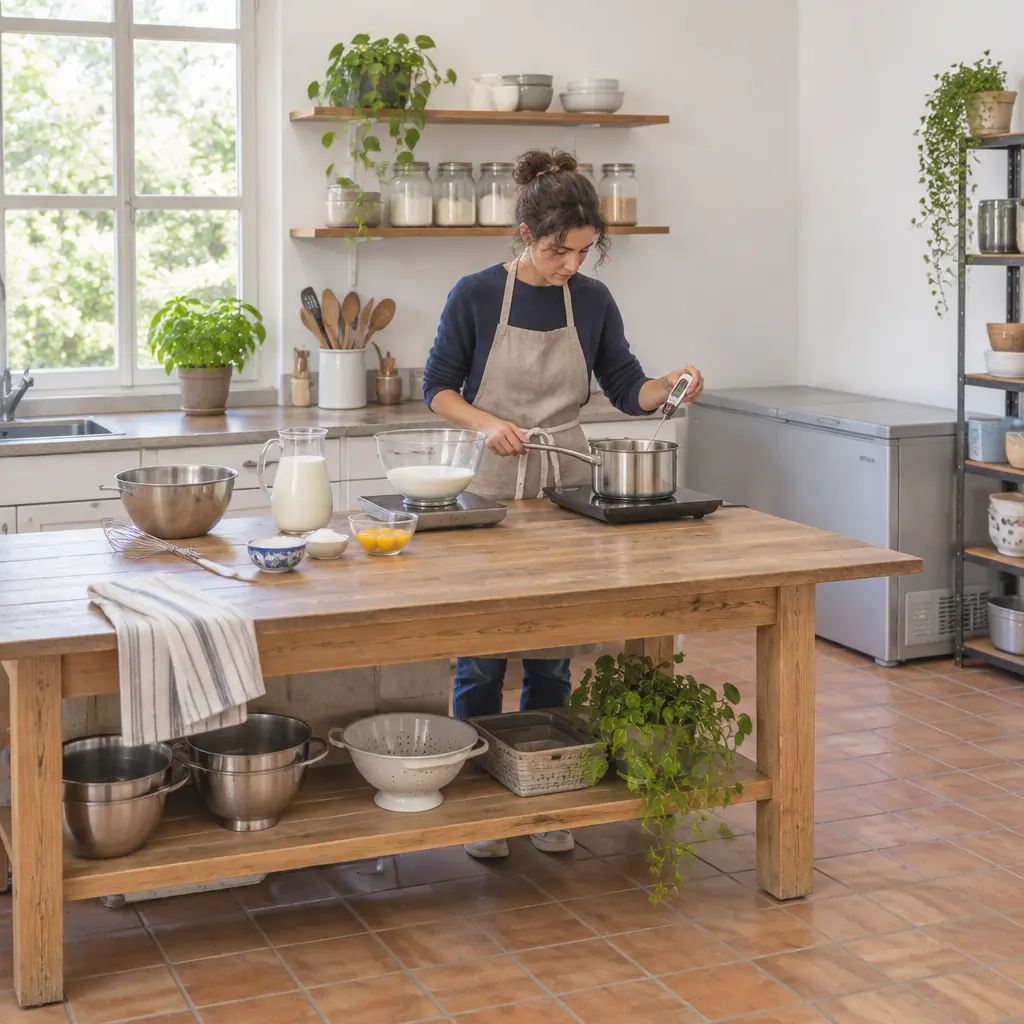
A digital kitchen scale measures ingredients by weight, while a thermometer checks the temperature of the heated base. These tools help reproduce results more reliably than estimating with cups or relying on visual cues. For custard-style bases, a thermometer is especially helpful when heating eggs and dairy: the U.S. Food and Drug Administration advises cooking egg dishes to 160°F (71°C) to reduce food-safety risk. Follow the specific recipe’s heating and cooling instructions, and avoid leaving dairy mixtures at room temperature for extended periods.
A heavy-bottomed saucepan distributes heat more evenly than a thin pan, reducing the chance of scorching milk or sugar. A whisk and a heat-resistant spatula help combine ingredients and scrape the pan’s sides. A fine-mesh strainer is useful for removing cooked egg particles, lumps, or flavoring solids before chilling the base.
A kitchen scale and thermometer are high-value basics
For most beginners, these are the most broadly useful precision tools. Weighing ingredients is particularly valuable when recipes specify dairy, sugar, and stabilizers in exact proportions. A probe thermometer can also check whether a cooked base has cooled sufficiently before it goes into the refrigerator. Choose a model with a readable display and a probe that can be cleaned easily; keep it from touching the bottom of the pan, which may be hotter than the mixture.
Freezing and churning equipment determines the method
An ice-cream maker freezes the base while a dasher moves it around the cold bowl or cylinder. Home machines commonly use one of two approaches: a pre-frozen bowl or a built-in compressor. Both can make gelato, though the machine’s design, batch capacity, and churning speed influence convenience and texture. A machine is not essential for every recipe, but it makes controlled, repeatable freezing much easier.
Freezer-bowl machines suit occasional batches
A freezer-bowl machine uses a double-walled bowl containing a freezing solution. The bowl must be frozen thoroughly before use, often for many hours; the manufacturer’s instructions determine the required time. These models are usually less expensive than compressor machines, but they require freezer space and generally need the bowl refrozen before another batch. Check bowl capacity and your freezer’s available room before buying.
Compressor machines suit frequent or back-to-back batches
A compressor machine has a built-in refrigeration system, so it can chill the bowl without pre-freezing. This is convenient for making multiple flavors in one session, but the machines are typically heavier, larger, and more costly. A compressor model is most worthwhile when you make frozen desserts often or do not have room to store a permanently frozen bowl. Compare the manufacturer’s stated batch capacity and cycle time rather than assuming that a larger appliance automatically produces better gelato.
Manual methods can work, with more attention
Without a machine, a shallow metal pan and a freezer can produce a frozen dessert by freezing the base and stirring it repeatedly as it firms. This method is inexpensive but requires hands-on timing and may create larger ice crystals or a less even texture than continuous churning. It is best treated as an accessible experiment, not as a direct substitute for a dedicated machine. A blender or food processor can help smooth some partially frozen mixtures, but it does not replace safe temperature control.
Storage tools protect gelato after churning
Once churned, gelato is soft and may need a short hardening period in the freezer. Shallow, freezer-safe containers allow it to cool more evenly than a deep, oversized tub. A lid helps protect the surface from air and freezer odors. The USDA Food Safety and Inspection Service recommends keeping a freezer at 0°F (-18°C) or below for safe long-term frozen storage; for serving quality, avoid repeated temperature swings and return the container to the freezer promptly.
Shallow containers and tight lids help preserve quality
Choose containers that fit the batch without leaving a large empty space, and use materials intended for freezer storage. A broad, shallow container makes it easier to portion the gelato and limits the depth through which the center must harden. Pressing a piece of baking parchment directly onto the surface can provide an additional barrier to air, although a secure lid remains important.
A freezer thermometer helps verify conditions
A separate freezer thermometer can confirm that the appliance is holding a suitable temperature, particularly if the freezer is frequently opened or packed tightly. The USDA’s 0°F (-18°C) benchmark is a useful safety reference, while stable cold storage also helps slow the formation of coarse ice crystals. Place containers away from the freezer door when possible, where temperature changes are more likely.
A practical home gelato equipment checklist
The following setup covers the main stages without requiring commercial equipment:
- A digital kitchen scale for weighing ingredients.
- A probe thermometer for checking heated and cooled mixtures.
- A heavy-bottomed saucepan, whisk, and heat-resistant spatula.
- A fine-mesh strainer for smoothing custard-style bases.
- A freezer-bowl or compressor ice-cream maker, if making gelato regularly.
- Shallow, lidded freezer-safe containers and a freezer thermometer.
For a first batch, use a tested recipe and follow the machine’s instructions for chilling the base, filling the bowl, and churning. Chill the base thoroughly before churning, avoid overfilling the machine, and transfer the finished gelato to a cold container. These steps are more useful than buying specialty tools before you know which recipes and batch sizes you prefer.
Conclusion: prioritize control over specialized gadgets
Essential home gelato equipment falls into three groups: tools for accurate measuring and safe heating, a freezing method suited to your routine, and containers that protect the finished dessert. A scale and thermometer improve consistency; a freezer-bowl machine offers an approachable entry point, while a compressor model favors frequent batches. Stable freezer conditions and suitable storage help maintain texture after churning. Start with the basics, follow food-safety guidance and a reliable recipe, then upgrade only when your habits or desired batch size justify it.
Sources: U.S. Food and Drug Administration, What You Need to Know About Egg Safety, https://www.fda.gov/consumers/consumer-updates/what-you-need-know-about-egg-safety; USDA Food Safety and Inspection Service, Freezing and Food Safety, https://www.fsis.usda.gov/food-safety/safe-food-handling-and-preparation/food-safety-basics/freezing-and-food-safety; University of Guelph, Understanding Ice Cream, https://www.uoguelph.ca/foodscience/book-page/understanding-ice-cream/